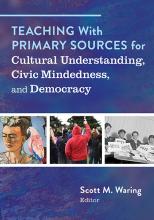
Read about inclusion in: Teaching with Primary Sources for Cultural Understanding, Civic Mindedness, and Democracy
Published on Wed, 03/13/2024
Primary Sources and Inclusion
Purchase this new book on Teaching with Primary Sources from Teachers College Press.
Framework for Inclusion: Physical, Pedagogical, and Narrative Accessibility
Published on Mon, 12/11/2023
A Comprehensive Approach to Full Inclusion
Effective implementation for all learners, especially the 7.5 million Special Education students in the United States, requires careful consideration of accessibility. In particular, educators must pay attention to critical accessibility principles:
Disability History Is Essential History - 2023 Report on the Teaching of Disability History
Published on Tue, 09/05/2023
Emerging America 2023 Survey on the Teaching of Disability History
By Rich Cairn, Emerging America
At the end of the 2021-2022 and 2022-2023 school years, Emerging America widely promoted an online survey of teachers to discover how much they teach disability history. Though the response has been small, the results offer intriguing insights.
Developing a K-12 Disability History Curriculum
Published on Tue, 08/01/2023
New Teaching Resource: Time Out – Spotlight Offensive Language in Primary Sources
Published on Thu, 04/27/2023
Every unit of the Reform to Equal Rights: K-12 Disability History Curriculum includes an introduction to the topic of disability, including strategies to address disrespectful vocabulary.
Language-aware lesson example: Colonial Daily Life (3rd Grade)
Explore primary sources to learn about daily life in Colonial Massachusetts.
Students will practice with posing questions about primary source documents and then analyzing the resources to learn more about life in Colonial Massachusetts. Students will summarize their learning in the final lesson.
What was everyday life like for people who lived near the ocean in Massachusetts 250 years ago?
What can a newspaper tell us about the lives of men, women, and children in 1767 Massachusetts?
Focus skills include:
Language-aware lesson example: Does the First Amendment say you can? (8th Grade)
Explore the First Amendment free speech rights
of students...through analysis of Supreme Court decisions.
Students will practice summarizing interpretations of Freedoms of Speech under
the First Amendment.
Language-aware lesson example: Is it ever okay to break a law? (High School)
Explore primary sources connected to the Civil Rights movement.
The English Learner Collaborations project of the Massachusetts Council for the Social Studies commissioned the development of lessons to illustrate applying English Language Development (ELD) teacher resources to History and Social Studies content.
By the end of the sequence of lessons linked below, students should be able to explain the principles of non-violent civil disobedience, and will be able to provide examples of non-violent civil disobedience.
Resources for Education During a Pandemic - an annotated compendium of links
This teaching resource is a blog post that receives periodic updates. Its introduction reads, in part:
On this page, we feature resources for teachers of History, Social Studies, and Civics who are designing curriculum in the context of the pandemic, both for students who may be learning from home, and for students navigating a changing environment no matter where teaching and learning happens.