

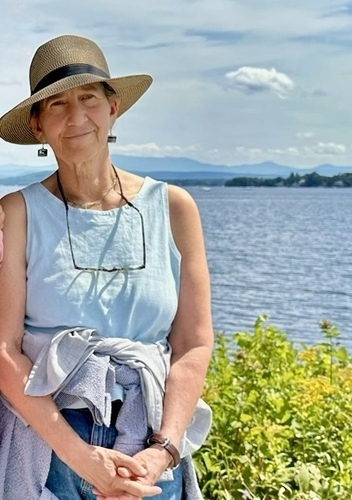
Remembering Laurie Block, Architect of Disability History 1951-2026
By Graham Warder
On September 8 of this year, we lost one of disability history’s founding forces. After a long struggle between cancer and Laurie Block, cancer finally won. Her death came just a month after that of her husband, novelist John Crowley. Though Laurie, my long time friend and a colleague is gone, her work continues. It is my sincere hope and expectation that her legacy will flourish in the coming years.
The first time I heard about Laurie Block was when Kathy Peiss’s graduate class on the history of the body at the University of Massachusetts Amherst watched Laurie’s 1991 film, Fit: Episodes in the History of the Body. That film, which was narrated by actress Linda Hunt and entirely consisted of archival footage that Laurie had researched and assembled, introduced me to disability and eugenics as historical subjects. At Keene State College, I continue to offer courses on those topics.
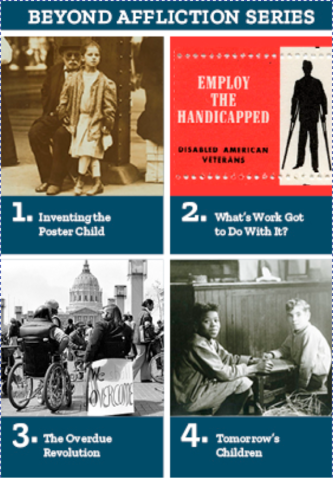
The first time I actually heard Laurie Block’s voice was on the radio. Produced with Jay Allison of National Public Radio, “Beyond Affliction: The Disability History Project” came out as four one-hour episodes in May of 1998. Those episodes, “Inventing the Poster Child,” “What’s Work Got to Do with It,” “The Overdue Revolution,” and “Tomorrow’s Children,” introduced the American public to disability history at a time when the field was in its infancy. In “Beyond Affliction,” Laurie’s voice was lilting and sweet. Only later did I discover that, by her own admission, it was all an act, a persona meant to connect with her audience. It worked.
Winner of the 1999 Robert F. Kennedy Senior Radio Journalism Award, “Beyond Affliction” was accompanied by a rather simple website. Laurie always sought to produce more and better materials, and the result was the launch of the Disability History Museum in 2000. Assisted by Steve Bromage, now the Executive Director of the Maine Historical Society, and Erik Haugsjaa, a software engineer currently based in Montreal, the site was custom made, and powered by a scalable database. In those days, creating a website was far more difficult than it is today, when so many off-the-shelf systems are available. Creating the Disability History Museum meant that Laurie had to make an endless number of decisions. One of those decisions was to hire a cataloger.
Lucky for me, Kathy Peiss recommended me for the position. I was just finishing my Ph.D. at UMass. I began teaching as an adjunct at Keene State College, but I was looking for more projects. (I later was hired into a tenure-track position at Keene State.) So Laurie hired me as Library Cataloger and Acquisitions Director of the Disability History Museum. Being in charge of “acquisitions” at a museum may sound impressive, but what I was really doing, I later realized, was to begin graduate school anew. My job was to locate, proof, and catalog a wide array of primary sources in United States disability history. Because the museum was breaking new ground for disability history in the digital world, we had to create almost everything from scratch. Sitting with Laurie in a barn in Conway, Massachusetts, converted into an office, her keen mind helped me to discover an intellectual world that I have never left. It was and is fascinating.
Over the next 25 years, at numerous conferences and meetings, Laurie introduced me to so many wonderful leaders in the field. In the early 2000s, I was lucky to meet and speak with Paul Longmore, Douglas Baynton, Cathy Kudlick, Kim Nielsen, and others. In 2009, as part of a National Endowment for the Humanities grant to develop disability history curriculum for the Disability History Museum, I met Rich Cairn. I continue to work closely with him on the Emerging America Reform to Equal Rights: K-12 Disability History Curriculum funded by the Library of Congress.
My personal professional journey became possible due to Laurie Block, and I will be forever grateful. Recently, thanks to Laurie’s foresight and tenacity, the Disability History Museum was acquired by the Viscardi Center in Albertson on Long Island, site of the bricks-and-mortar Museum of Disability History. John Sears and I now serve on the Museum Board of the Viscardi Center. We are both committed to preserving and expanding on Laurie’s vision and work for disability history as an integral part of the American story.
Photo Credits
- Daily Hampshire Gazette obituary for Laurie Block.
- Screenshot of Beyond Affliction Series from the Disability History Museum.
